FIFA History Explained: How It All Started in 1904
Football is the undisputed king of global sports, and behind its massive matches sits a single governing body: FIFA. Short for the Fédération Internationale de Football Association, this organization manages everything from local transfer rules to the multi-billion dollar world cup.
Looking back at the archive logs, it is wild to see how a tiny meeting behind a Paris storefront grew into a massive sporting empire. This breakdown covers the origins of the group, early tournament struggles, the wartime freeze, and the shift toward modern technology.
FIFA History – The Birth of FIFA in 1904
International football was a messy affair at the turn of the twentieth century. Teams played by conflicting regional rules, making cross-border matches chaotic.
Formation in Paris
On May 21, 1904, football representatives from seven European nations met at the back of the Union des Sociétés Françaises de Sports Athlétiques building in Paris. France, Belgium, Denmark, the Netherlands, Spain, Sweden, and Switzerland signed the foundation charter.
The Original Goal
The primary reason for creating the group was simple: establish a single, unified set of rules for international play. The founders wanted to ensure that a foul in Paris meant the exact same thing as a foul in Amsterdam.
Early Roadblocks
Getting the rest of the world to listen was not easy. The British Home Associations, who considered themselves the inventors of modern football, initially ignored the group, viewing the mainland European organization with skepticism.
Early Development of FIFA (1904–1930)
The early years were defined by slow, grinding administrative growth rather than massive stadium crowds.
Coordination Struggles
Money was tight, and the group had no permanent headquarters. Organizing simple international fixtures required months of postal mail correspondence.
Entering the British Teams
The English Football Association finally joined the ranks in 1905. Their arrival gave the young organization a massive boost in global credibility, though the British nations would slide in and out of membership over the following decades due to political disagreements.
First Major Match Frameworks
The group took over management of the Olympic football tournaments starting with the 1908 London Games. These early amateur brackets served as the blueprint for what would eventually become independent international tournaments.
The First FIFA World Cup (1930)
By 1928, Olympic amateur rules were too restrictive for the growing professional side of the sport. FIFA President Jules Rimet decided it was time for an independent open championship.
The Choice of Host
The group chose Uruguay to host the inaugural 1930 tournament. The South American nation was celebrating its centenary of independence and had won consecutive Olympic gold medals, proving their playing quality.
Traveling Across the Atlantic
European teams were hesitant to make the long trip. Traveling across the ocean required an expensive two-week boat journey, which meant only four European nations agreed to sail down to Montevideo.
The Historic Outcome
Uruguay defeated neighbors Argentina 4-2 in the final to lift the first trophy. The financial and athletic success of the tournament proved that international football could generate huge global audiences outside of Europe.
FIFA During World War Era
The geopolitical conflict of the mid-twentieth century brought global sports administration to a sudden halt.
The Tournament Cancellations
World War I slowed the group’s operations, but World War II completely froze them. The planned 1942 and 1946 tournaments were canceled as nations redirected all resources toward war efforts.
Guarding the Trophy
During the war, FIFA Vice-President Ottorino Barassi secretly removed the World Cup trophy from a bank vault in Rome. He hid it in a shoebox under his bed to prevent occupying troops from seizing the gold.
Rebuilding After 1945
The organization faced a fractured landscape when peace returned. Many stadiums lay in ruins, and several nations were banned from competition, forcing a slow rebuilding phase that culminated in the 1950 tournament in Brazil.
Expansion of FIFA and the World Cup (1950–1990)
The post-war era transformed football from a regional pastime into a broadcast television powerhouse.
The Power of Television
The 1954 tournament in Switzerland was the first to be broadcast on television screens. Suddenly, fans worldwide could watch legends like Pelé, Franz Beckenbauer, and Dino Zoff without buying a stadium ticket.
Introducing the Qualifiers
As dozens of newly independent nations from Africa and Asia joined the organization, the tournament format had to adjust. Strict regional qualifying brackets were built to give every continent a fair path to the main draw.
Modern FIFA Era (1990–Present)
By the turn of the century, football had evolved into a multi-billion-dollar commercial industry.
Media Rights and Sponsorships
Television broadcast rights grew into massive financial packages. Corporate sponsorships turned the sport into a global commercial ecosystem, funding stadium builds and grassroots development programs across the world.
Format Expansion
The tournament field expanded to 24 teams in 1982, hit 32 teams in 1998, and has now scaled up to its largest size yet. For a complete breakdown of how the current structure works, check out our beginners guide FIFA World Cup 2026 to see how the groups are organized.
The Age of Technology
The modern era also changed how matches are managed on the pitch. The introduction of the Video Assistant Referee (VAR) system in 2018 gave officials the power to review close calls, reducing human error in high-stakes matches.
Key Milestones in FIFA History
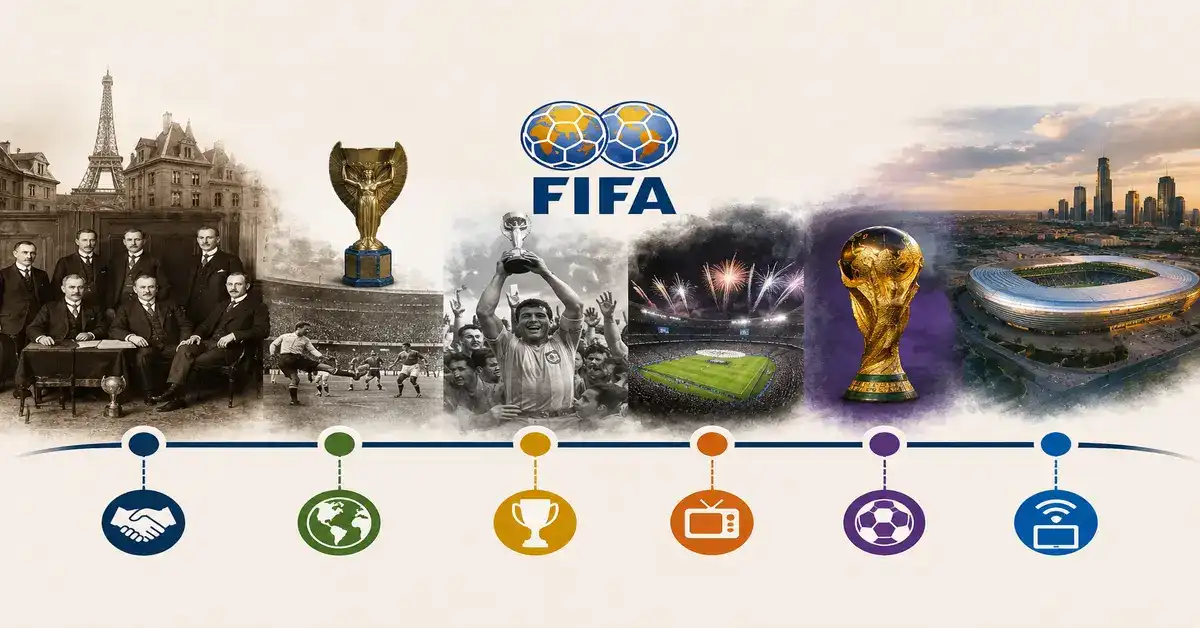
To keep the timeline simple, fans track history across a few defining calendar years:
| Year | Milestone Event | Historical Significance |
| 1904 | Foundation in Paris | Seven nations unite international football rules. |
| 1930 | First World Cup | Uruguay hosts and wins the inaugural open tournament. |
| 1974 | New Trophy Design | The modern solid-gold trophy design debuts in Germany. |
| 1998 | 32-Team Bracket | The tournament expands to include more global representation. |
| 2018 | VAR Introduction | Video replay technology enters to assist referee decisions. |
| 2026 | 48-Team Field | The largest tournament expansion kicks off across North America. |
Famous Moments in FIFA History
The history of the sport is built around iconic moments that fans still debate decades later.
The Maracanazo (1950)
Over 170,000 fans packed Rio’s Maracanã stadium expecting Brazil to win the trophy. In one of the biggest upsets in sports history, Uruguay fought back to win 2-1, silencing the host nation.
England’s Home Win (1966)
England secured their lonely world title on home soil in a dramatic 4-2 final against West Germany, featuring a controversial ghost goal that remains a topic of debate today.
The Hand of God (1986)
Diego Maradona scored two iconic goals against England in the quarterfinals. The first was a clever handball the referee missed, and the second was a stunning solo run past five defenders, showing the two sides of his genius.
FIFA’s Impact on Global Football
The governing body has changed the cultural and financial weight of international sports.
Economic and Infrastructure Shifts
Hosting a major tournament forces cities to upgrade transportation lines, build modern stadiums, and invest in local hospitality industries, creating long-term economic footprints.
Youth and Women’s Football
The launch of the Women’s World Cup in 1991 altered the sports landscape completely. Regular investment in under-17 and under-20 brackets ensures that young players have a clear path to professional careers.
Final Thoughts
The journey from a quiet room in Paris to a global sporting empire shows the universal appeal of football. While political shifts and commercial expansion have changed how the business operates, the basic game remains untouched. For real-time tournament tracking, live match updates, and football guides, fans continue to look to Total Sportek for full sports coverage.