
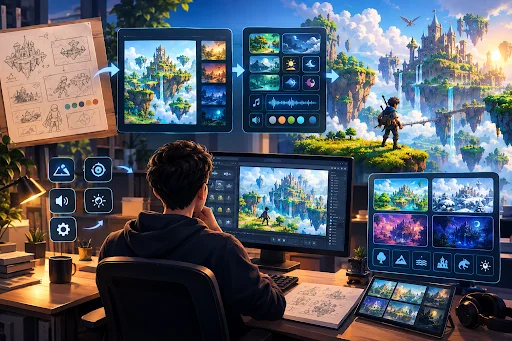
AI Game Maker Guide for Building Unique Game Worlds
A memorable game world doesn’t require massive scale or photorealistic graphics. It requires a clear identity, a specific personality that makes the world feel like a cohesive place rather than a collection of features assembled from a template. Building that identity used to demand enormous technical infrastructure and specialized artistic skill.
Modern AI game makers have democratized world-building in a way that lets creators focus entirely on the creative decisions that actually define what makes a world feel unique, removing the technical complexity that used to stand between vision and execution.
Why Unique Worlds Matter More Than Scale
Players remember games not because of how big the worlds were, but because of how the worlds felt. A small game world with a clear personality and intentional design choices tends to stick in memory far more than a massive world that feels generic. That personality comes from thousands of small decisions about atmosphere, pacing, visual and audio identity, and the specific rules that govern how the world operates.
Building that personality doesn’t require infinite resources or a massive team. It requires clarity about what makes your world specifically different from others, and the discipline to make deliberate choices that reinforce that identity throughout every element a player experiences.
How AI Game Makers Support World Building
Handling Technical Infrastructure Automatically
Creating a cohesive game world used to require significant technical work just to make everything function together, asset management, lighting systems, physics interactions, all of it needed implementation before you could even test whether the world actually felt right. AI game makers automate much of that underlying infrastructure, letting creators describe what they want the world to be and seeing it reflected immediately.
This automation means technical constraints stop limiting creative choices. A creator can decide a world should have specific weather patterns, unique physics properties, or particular visual characteristics without needing to understand the technical implementation underneath. The platform handles the translation, and the creator focuses on whether the result actually achieves the intended atmosphere.
Making Iteration on Atmosphere and Feel Fast
The most important part of building a unique world is getting its personality right, and that requires constant iteration based on how the world actually feels when you move through it. AI tools make adjusting atmosphere elements nearly instant, testing how a lighting change affects mood, how environmental audio influences the experience, how specific color palettes shape perception of the space.
That fast iteration is genuinely crucial for world building, since atmosphere is something you can’t fully predict without experiencing it directly. Testing a change and immediately feeling the effect means refining a world’s personality becomes practical rather than theoretical.
Supporting Consistent Rules and Logic
Unique worlds have consistent internal logic, rules that govern how things work, limitations that make the world feel real rather than arbitrary. AI tools make establishing and maintaining that consistency straightforward, handling the technical requirements of tracking those rules and ensuring they apply consistently throughout the player’s experience.
Building Blocks of a Unique Game World
Define Your World’s Core Identity
Before building anything, get specific about what makes your world fundamentally different. Is it a place defined by specific weather or environmental conditions? By unusual physics or gravity? By a particular historical period or culture? By unique inhabitants and their specific behaviors? That core identity should be something you can articulate in a single sentence, and every design decision that follows should reinforce it.
This clarity matters because it gives you a concrete target for all your creative choices. Rather than making decisions in isolation, you’re always asking whether this choice serves the core identity or distracts from it. That discipline produces worlds that feel cohesive rather than scattered.
Establish Visual and Audio Language
A unique world has a distinctive look and sound, consistent choices about color palettes, architecture style, visual hierarchy, audio tone, all of it working together to create a specific mood. Those choices need to be deliberate rather than accidental, made by you rather than defaulting to whatever the platform provides by default.
AI tools make experimenting with different visual and audio approaches fast enough that you can test several directions and choose the strongest one. A world can look different based on lighting, can feel different based on sound design, and those variations should all reinforce your core identity rather than working against it.
Design Meaningful Interactions With the Environment
The most distinctive worlds let players interact with their environment in ways that feel specific to that world. Not just generic action-object interactions, but things that make sense specifically in this place, with these rules, with this atmosphere. Those meaningful interactions make the world feel alive rather than like a backdrop for the actual game.
AI tools handle the technical requirements of tracking those interactions, letting you focus on designing what makes sense in your specific world and what would feel out of place.
Practical Approaches to Building Unique Worlds
Start With Atmosphere, Add Content Later
Rather than starting with content and hoping atmosphere emerges, start by establishing the world’s fundamental feel. Before building levels or populating spaces with content, get clear on what walking into this world should make a player feel. Test that atmosphere in a simple, rough space before adding complexity on top of it.
This foundation-first approach means you’re not layering content on top of an undefined atmosphere. Every addition to the world after that should reinforce what you’ve already established.
Test How Worlds Feel in Motion
A world’s personality reveals itself not through staring at static screenshots, but through moving through it. How does it feel to navigate this space? Does the pacing make sense? Are there moments of visual or audio contrast that keep the experience engaging? Those questions only get answered by moving through an actual playable version.
AI tools make building those playable test versions fast enough that you can spend significant time in rough versions of your world, feeling how they actually play, adjusting based on direct experience rather than theory.
Iterate on Specific Atmospheric Elements
Rather than trying to refine an entire world at once, focus iteration on specific elements. Spend a session refining lighting and how it shapes mood. Spend another on audio and how it influences atmosphere. Another on environmental detail and visual storytelling. That focused iteration means each round of testing has clear direction rather than diffuse changes that don’t clearly improve or harm the experience.
A Clear Example of Unique World Building
Minecraft Snow World demonstrates what intentional world building produces, a space with clear identity and personality that makes it feel like a cohesive place rather than a generic snowy environment. The world’s atmosphere and the way it feels to move through it are products of deliberate choices reinforcing a specific vision.
This kind of focused, intentional world building is increasingly achievable for independent creators using an AI game maker, since the technical infrastructure that used to consume enormous time can now be handled automatically, letting human creativity focus on what actually determines whether a world feels unique.
What Creates Memorable Worlds
Specificity Over Generic Features
Generic features, forests that look like every other forest, castles that follow familiar patterns, don’t create memorable worlds. Specificity does. A forest with unusual weather, specific wildlife, particular historical remnants, a castle with specific architectural quirks and a clear purpose, those details create personality.
That specificity comes from decisions you make about what this particular world is, not from generic features the tool provides by default.
Consistency That Reinforces Identity
Every element of a world should feel like it belongs. That sense of belonging comes from consistency in how things are designed, how they interact, what the underlying rules actually are. Inconsistency breaks immersion, making the world feel like arbitrary systems rather than a cohesive place.
Atmosphere That Shapes Player Perception
How a world feels matters as much as what it contains. Lighting, audio, pacing, visual hierarchy, all of these shape mood and perception in ways that direct gameplay and clear mechanical systems never could. A world designed with deliberate atmospheric choices feels alive in a way that mechanically identical worlds without that attention simply don’t.
What AI Tools Don’t Do For You
Decide What Makes Your World Unique
Tools can execute the technical requirements of building a world, but they don’t decide what makes your specific world different from others. That vision, that clarity about what you’re actually building and why, comes entirely from you.
Replace the Need for Testing and Iteration
Building a unique world requires experiencing it directly, moving through it, adjusting based on how it actually feels. No tool replaces the need to spend time in your world, noticing what works and what doesn’t, refining based on observation rather than assumption.
Generate Creative Choices Automatically
The specific decisions that make a world unique, color choices, architectural style, audio tone, pacing, all of it requires creative judgment from the person building the world. Tools handle implementation, you handle creativity.
Final Thoughts
Building unique game worlds with AI game makers means using those tools to handle technical complexity automatically so human creativity can focus entirely on the decisions that actually create personality and atmosphere.
Start with a clear identity, test that identity in simple rough spaces, iterate based on how the world actually feels, and let every decision reinforce your core vision. The worlds that stick in players’ memory aren’t the biggest or most technically impressive, they’re the ones that feel like cohesive, intentional places shaped by specific creative vision.
That kind of world-building has become far more accessible for independent creators, since technical barriers no longer stand between imagination and playable reality.
